
Questions to Ask Your Title Company in a Commercial Real Estate Transaction

Closing a commercial real estate deal can feel like juggling a dozen moving pieces at once — contracts, surveys, loans, inspections, fees, and closing documents, to name a few.
Your title company is a key player in the transaction. In Texas, title companies don’t just issue title insurance, although that is a critical function they serve. They also typically act as the escrow agent and hub of the transaction: coordinating funding, managing documents, receiving and disbursing funds, and helping make sure the deal closes smoothly and on time.
An experienced and reputable title company should communicate with you about developments in the transaction and information and items needed for closing and issuance of the title insurance policy. But asking the right questions early can also prevent last-minute surprises, delays, or costly legal issues.
Below is a practical guide to the key questions you should consider asking your title company when closing a commercial real estate transaction.
🏢 Understanding the Title
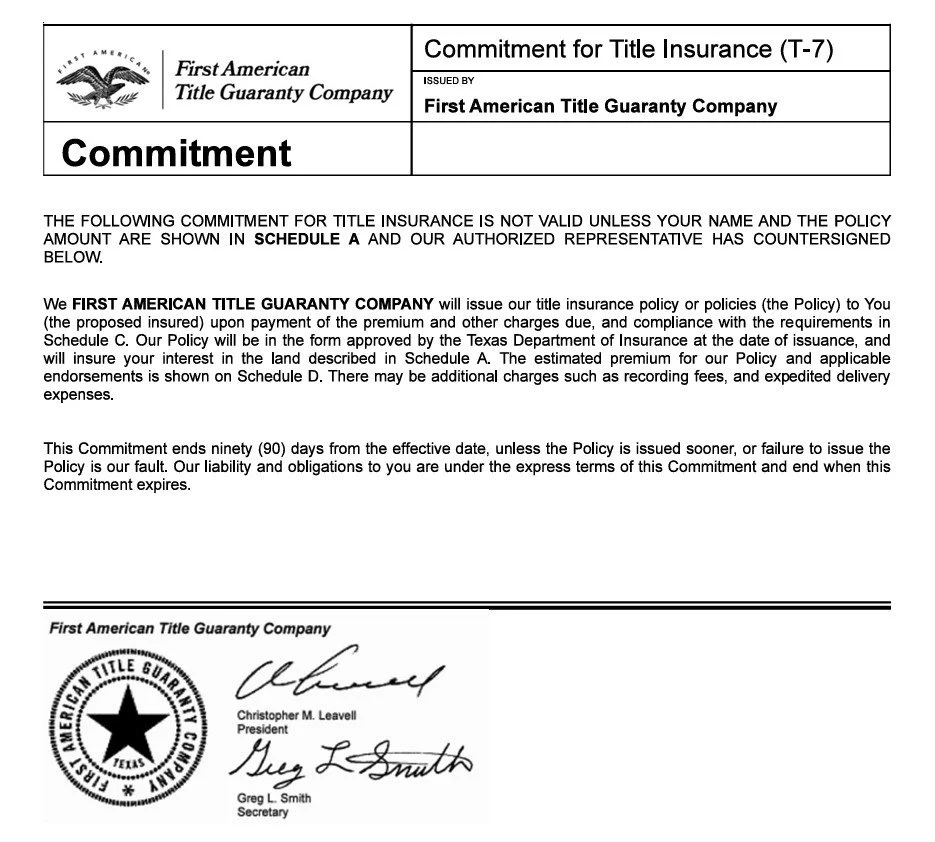
1. When will we receive the title commitment?
The title commitment outlines:
Who owns the property
Existing liens
Easements
Restrictions
Requirements to close
After the title company opens your file, it should initiate a search of the property’s title and provide you with a title commitment once that search is completed. You can ask to receive the title commitment as soon as possible so that you and/or your attorney have time to review and object to issues.
2. What steps do we need to take to satisfy the requirements to obtain a title policy?
Schedule C of the title commitment will identify any requirements that must be met in order to close the transaction and issue the title policy. The most common requirements of parties to the transaction, in coordination with the title company, include:
Obtaining payoff statements for all outstanding liens on the property
Securing releases of all pending judgments or lawsuits against the seller of the property
Ensuring property taxes and association fees are current
Providing entity documents that authorize representatives to sign closing documents on behalf of the entity
Submitting a survey of the property for review and approval
Obtaining tenant estoppels or Subordination, Non-Disturbance and Attornment Agreements (SNDAs), if applicable
To ensure a timely closing, it’s important to communicate with your title company early in the process about the specific information you need to provide to satisfy all closing requirements.
3. Do we need to obtain a new survey or can we use an existing survey?
If the buyer or lender in the transaction would like the obtain “survey coverage” in the title policy – insurance protection against problems with the property that a land survey would reveal – a survey will need to be provided to the title company. Importantly, a new survey is not required in every real estate transaction. If the title company can be provided with an existing survey, along with an affidavit from the property owner attesting that there have been no changes to the property since the date of the survey, that will often be sufficient for a title company to provide survey coverage.
Note: if a survey reveals encroachments or boundary issues, those will need to be resolved before closing.
4. What endorsements should we consider?
The basic title policy may not provide all of the insurance coverage that a buyer or lender desire. It’s important to ask the title company about adding endorsements to the policy for extra protection.
Common commercial endorsements include:
· Access to the property from a roadway or easement
· Contiguity (insuring multiple parcels touch)
· Survey coverage
· Restrictions, encroachments, and minerals
Ask your title company: what endorsements do you recommend for this property and why? What is the cost associated with each endorsement?
💰 Understanding Escrow, Money & Closing Mechanics

5. What fees will we incur?
The fees for the transaction will be set forth in the closing statement, also referred to as a settlement statement and closing disclosure, which the title company will prepare. The parties typically agree in a real estate contract how closing fees will be split between them. Closing fees generally fall into two categories: (1) loan fees and (2) title fees. Loan fees are charged by a lender in a transaction and typically paid by the buyer/borrower. Loan fees can include appraisal fees, origination fees, and other costs the lender incurs in connection with the loan. The lender discloses those fees to the title company, which includes them on the closing statement.
Title fees typically include:
· Title premium and endorsement fees (in Texas, rates are set by the Texas Department of Insurance)
· Escrow fees
· Courier/wire fees
· Recording fees
Other costs like survey fees, attorney fees, mobile notary fees, and association fees may also be included on the closing statement.
The timing of when you will receive a draft closing statement usually depends on whether or not the transaction is financed. If a lender is involved, the title company will often wait to receive the loan fees before preparing the statement. If the transaction is cash, the title company can usually prepare the statement as soon as it has all the information to be included.
6. Will taxes be paid at closing or prorated?
If property taxes are due and payable at the time of closing, the title company will need to collect funds for and pay the taxes at closing. Unless otherwise agreed, each party to the transaction will be responsible for the portion of the taxes corresponding to the percentage of the tax year that they own the property.
If, however, property taxes are not due and payable at the time of closing, the title company will calculate each party’s prorated share of the estimated taxes that will be due at the end of the year (in Texas, property taxes are paid in arrears) based upon the percentage of the year that the seller and the buyer own the property respectively. Because the buyer will pay the full tax bill at the end of the year, the buyer receives a credit from the seller for the seller’s portion of the taxes. The proration is shown as a line item (debit to seller / credit to buyer) on the closing statement.
In addition to property taxes, other items that may be prorated in a commercial transaction include: association fees, rents, CAM charges, and security deposits.
Note: if the current year’s property taxes are not finalized at the time of closing, the title company will prorate based on the prior year’s property taxes.
7. Will the closing be in person or remote/electronic?
In many commercial real estate transactions today, the parties no longer have to sit at a closing table in the title company’s office. Most commercial deals today close using some combination of:
· In-person signing
· Remote signing with a notary
· Remote Online Notarization (RON)
· E-signing
The method of signing will typically be dictated by the particular documents to be signed, lender requirements, and deal complexity. Many lenders will not accept electronic signatures or RON notarizations. In those cases, the parties must “wet ink” sign in the presence of a notary. If parties are not located near the title company’s office, a mobile notary or notary at the party’s attorney’s office is often used. The signed documents are then sent to the title company. If permitted, a remote online notary is another option. Documents that do not need to be notarized or “wet ink” signed can often be signed electronically.
8. When will the transaction fund?
Whether a transaction will fund the same day that the closing documents are signed depends on certain factors. If the deal is financed, the title company will often need lender approval before it can disburse funds. Most lenders will approve funding by reviewing electronic scans of the signed documents, but others will not authorize funding until they receive and review the signed originals.
The timing of funding also depends on the time of day that the title company receives and reviews all of the signed closing documents. If that time is at or after the title company’s bank’s wire cutoff time, funding will not occur until the next day.